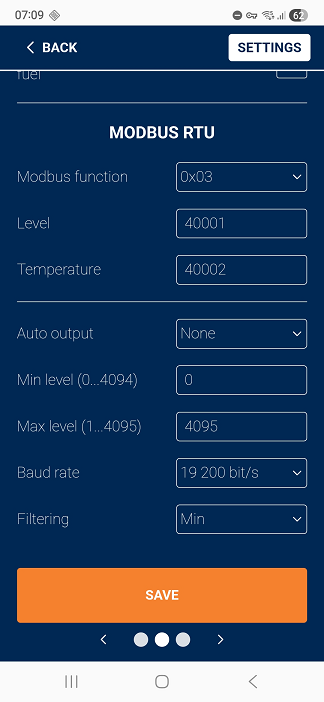
Configuration of Omnicomm LLS 5 EX sensors
Set up configuration parameters as described below:
Address (from 1 to 254) – set the network address of the Omnicomm LLS fuel level sensor. When several sensors are connected to one external device, the network addresses must be unique.
Automatic adjustment — enable this option to automatically correct measurements when the dielectric constant of the fuel changes. When auto-adjustment is enabled, level variations caused by fuel thermal expansion are also taken into account, meaning the displayed level will reflect the current temperature.
When using auto-adjustment, consider the following:
- For the Omnicomm LLS sensor to automatically correct its calibration values, the vehicle’s fuel tank must be completely filled during operation.
- When the fuel tank is fully filled, the maximum length of the sensor’s measuring part that remains above the fuel must not exceed 10 cm from the sensor flange.
- If the vehicle is operated with an insufficient fuel level in the tank, auto-adjustment cannot be performed.
Auto output – select:
- No output – autonomous data output (without request) is not performed.
- Binary – autonomous data output in binary format.
- Character – autonomous data output in character format.
- Data output interval (from 1 to 255 seconds) – set the interval for autonomous data output.
Min level (from 0 to 1023) – select the minimum reading of the LLS fuel level sensor. The default value is 0.
Max level (from 1 to 4095) – select the maximum reading of the LLS fuel level sensor. The default value is 4095.
Baud rate - select the speed at which data exchange with the external device will be performed. The default value is 19200 bit/s.
Filtering – set the output signal filtering parameters:
- None – no filtering is applied. Used when filtering is performed by an external device.
- Minimum – filtering is used when installed in stationary fuel storage tanks and low-mobility equipment.
- Medium – filtering is used when the vehicle operates under normal road conditions.
- Maximum – filtering is used when the vehicle operates under harsh road conditions.