
Login
You are currently not logged in! Enter your authentication credentials below to log in. You need to have cookies enabled to log in.
Configuration of Omnicomm LLS 4 sensors
Set up configuration parameters as described below:
Address (from 1 to 254) – set the network address of the Omnicomm LLS fuel level sensor. When several sensors are connected to one external device, the network addresses must be unique.
Auto output – select:
- No output – autonomous data output (without request) is not performed.
- Binary – autonomous data output in binary format.
- Character – autonomous data output in character format.
- Data output interval (from 1 to 255 seconds) – set the interval for autonomous data output.
Min level (from 0 to 1023) – select the minimum reading of the LLS fuel level sensor. The default value is 0.
Max level (from 1 to 4095) – select the maximum reading of the LLS fuel level sensor. The default value is 4095.
Baud rate - select the speed at which data exchange with the external device will be performed. The default value is 19200 bit/s.
Filtering – set the output signal filtering parameters:
- None – no filtering is applied. Used when filtering is performed by an external device.
- Minimum – filtering is used when installed in stationary fuel storage tanks and low-mobility equipment.
- Medium – filtering is used when the vehicle operates under normal road conditions.
- Maximum – filtering is used when the vehicle operates under harsh road conditions.
Heavy exploitation conditions - it is recommended to keep this setting ON when the vehicle frequently operates under harsh conditions. For normal road conditions, this setting can remain OFF to allow faster response times.

Configuration of Omnicomm LLS 4 AF sensors
Set up configuration parameters as described below:
On the “Settings” tab, in the “Configurable parameters” section:
Filtering – set the output signal filtering parameters:
- None – no filtering is applied. Used when filtering is performed by an external device.
- Minimum – filtering is used when the device is installed in stationary fuel storage tanks and low-mobility equipment.
- Medium – filtering is used when the vehicle operates under normal road conditions.
- Maximum – filtering is used when the vehicle operates under harsh road conditions.
Signal type – select Analog or Frequency.
For an analog signal:
- Max. voltage value (5 … 20) V – set the maximum voltage value. The default value is 5 V.
- Min. voltage value (0 … 15) V – set the minimum voltage value. The default value is 0 V.
For a frequency signal:
- Max. frequency value (100 to 2000) Hz – set the maximum frequency value. The default value is 2000 Hz.
- Min. frequency value (30 to 1900) Hz – set the minimum frequency value. The default value is 30 Hz.
When connected to Omnicomm terminals, the configured maximum and minimum frequency values must be within the range from 30 to 1053 Hz
- Pull-up – if, according to the manufacturer’s description, a voltage signal is connected to the input of the external device, select On. If a “dry contact” signal or an NPN transistor switch is connected, select Off.
Configuration of Omnicomm LLS 5 sensors
Set up configuration parameters as described below:
Address (from 1 to 254) – set the network address of the Omnicomm LLS fuel level sensor. When several sensors are connected to one external device, the network addresses must be unique.
Automatic adjustment — enable this option to automatically correct measurements when the dielectric constant of the fuel changes. When auto-adjustment is enabled, level variations caused by fuel thermal expansion are also taken into account, meaning the displayed level will reflect the current temperature.
When using auto-adjustment, consider the following:
- For the Omnicomm LLS sensor to automatically correct its calibration values, the vehicle’s fuel tank must be completely filled during operation.
- When the fuel tank is fully filled, the maximum length of the sensor’s measuring part that remains above the fuel must not exceed 10 cm from the sensor flange.
- If the vehicle is operated with an insufficient fuel level in the tank, auto-adjustment cannot be performed.
Auto output – select:
- No output – autonomous data output (without request) is not performed.
- Binary – autonomous data output in binary format.
- Character – autonomous data output in character format.
- Data output interval (from 1 to 255 seconds) – set the interval for autonomous data output.
Output interval - determines how frequently the LLS sensor sends data to the connected device. Shorter intervals provide more frequent updates but may increase data traffic. Longer intervals reduce traffic and power consumption but delay updates.
Min level (from 0 to 1023) – select the minimum reading of the LLS fuel level sensor. The default value is 0.
Max level (from 1 to 4095) – select the maximum reading of the LLS fuel level sensor. The default value is 4095.
Baud rate - select the speed at which data exchange with the external device will be performed. The default value is 19200 bit/s.
Filtering – set the output signal filtering parameters:
- None – no filtering is applied. Used when filtering is performed by an external device.
- Minimum – filtering is used when installed in stationary fuel storage tanks and low-mobility equipment.
- Medium – filtering is used when the vehicle operates under normal road conditions.
- Maximum – filtering is used when the vehicle operates under harsh road conditions.

Configuration of Omnicomm LLS 5 EX sensors
Set up configuration parameters as described below:
Address (from 1 to 254) – set the network address of the Omnicomm LLS fuel level sensor. When several sensors are connected to one external device, the network addresses must be unique.
Automatic adjustment — enable this option to automatically correct measurements when the dielectric constant of the fuel changes. When auto-adjustment is enabled, level variations caused by fuel thermal expansion are also taken into account, meaning the displayed level will reflect the current temperature.
When using auto-adjustment, consider the following:
- For the Omnicomm LLS sensor to automatically correct its calibration values, the vehicle’s fuel tank must be completely filled during operation.
- When the fuel tank is fully filled, the maximum length of the sensor’s measuring part that remains above the fuel must not exceed 10 cm from the sensor flange.
- If the vehicle is operated with an insufficient fuel level in the tank, auto-adjustment cannot be performed.
Auto output – select:
- No output – autonomous data output (without request) is not performed.
- Binary – autonomous data output in binary format.
- Character – autonomous data output in character format.
- Data output interval (from 1 to 255 seconds) – set the interval for autonomous data output.
Min level (from 0 to 1023) – select the minimum reading of the LLS fuel level sensor. The default value is 0.
Max level (from 1 to 4095) – select the maximum reading of the LLS fuel level sensor. The default value is 4095.
Baud rate - select the speed at which data exchange with the external device will be performed. The default value is 19200 bit/s.
Filtering – set the output signal filtering parameters:
- None – no filtering is applied. Used when filtering is performed by an external device.
- Minimum – filtering is used when installed in stationary fuel storage tanks and low-mobility equipment.
- Medium – filtering is used when the vehicle operates under normal road conditions.
- Maximum – filtering is used when the vehicle operates under harsh road conditions.

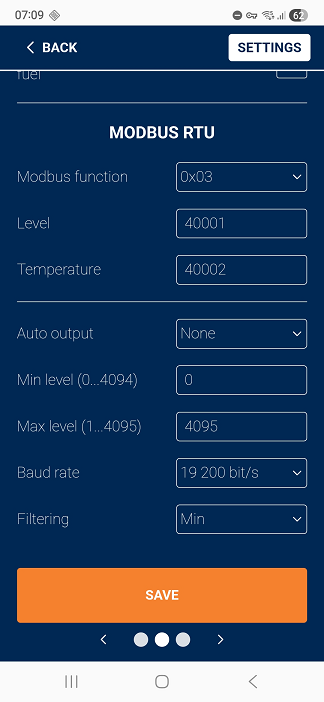
Configuration of Omnicomm LLS 6 sensors
Set up configuration parameters as described below:
Address (from 1 to 254) – set the network address of the Omnicomm LLS fuel level sensor. When several sensors are connected to one external device, the network addresses must be unique.
Automatic adjustment — enable this option to automatically correct measurements when the dielectric constant of the fuel changes. When auto-adjustment is enabled, level variations caused by fuel thermal expansion are also taken into account, meaning the displayed level will reflect the current temperature.
When using auto-adjustment, consider the following:
- For the Omnicomm LLS sensor to automatically correct its calibration values, the vehicle’s fuel tank must be completely filled during operation.
- When the fuel tank is fully filled, the maximum length of the sensor’s measuring part that remains above the fuel must not exceed 10 cm from the sensor flange.
- If the vehicle is operated with an insufficient fuel level in the tank, auto-adjustment cannot be performed.
Auto output – select:
- No output – autonomous data output (without request) is not performed.
- Binary – autonomous data output in binary format.
- Character – autonomous data output in character format.
- Data output interval (from 1 to 255 seconds) – set the interval for autonomous data output.
Min level (from 0 to 1023) – select the minimum reading of the LLS fuel level sensor. The default value is 0.
Max level (from 1 to 4095) – select the maximum reading of the LLS fuel level sensor. The default value is 4095.
Baud rate - select the speed at which data exchange with the external device will be performed. The default value is 19200 bit/s.
Filtering – set the output signal filtering parameters:
- None – no filtering is applied. Used when filtering is performed by an external device.
- Minimum – filtering is used when installed in stationary fuel storage tanks and low-mobility equipment.
- Medium – filtering is used when the vehicle operates under normal road conditions.
- Maximum – filtering is used when the vehicle operates under harsh road conditions.


